
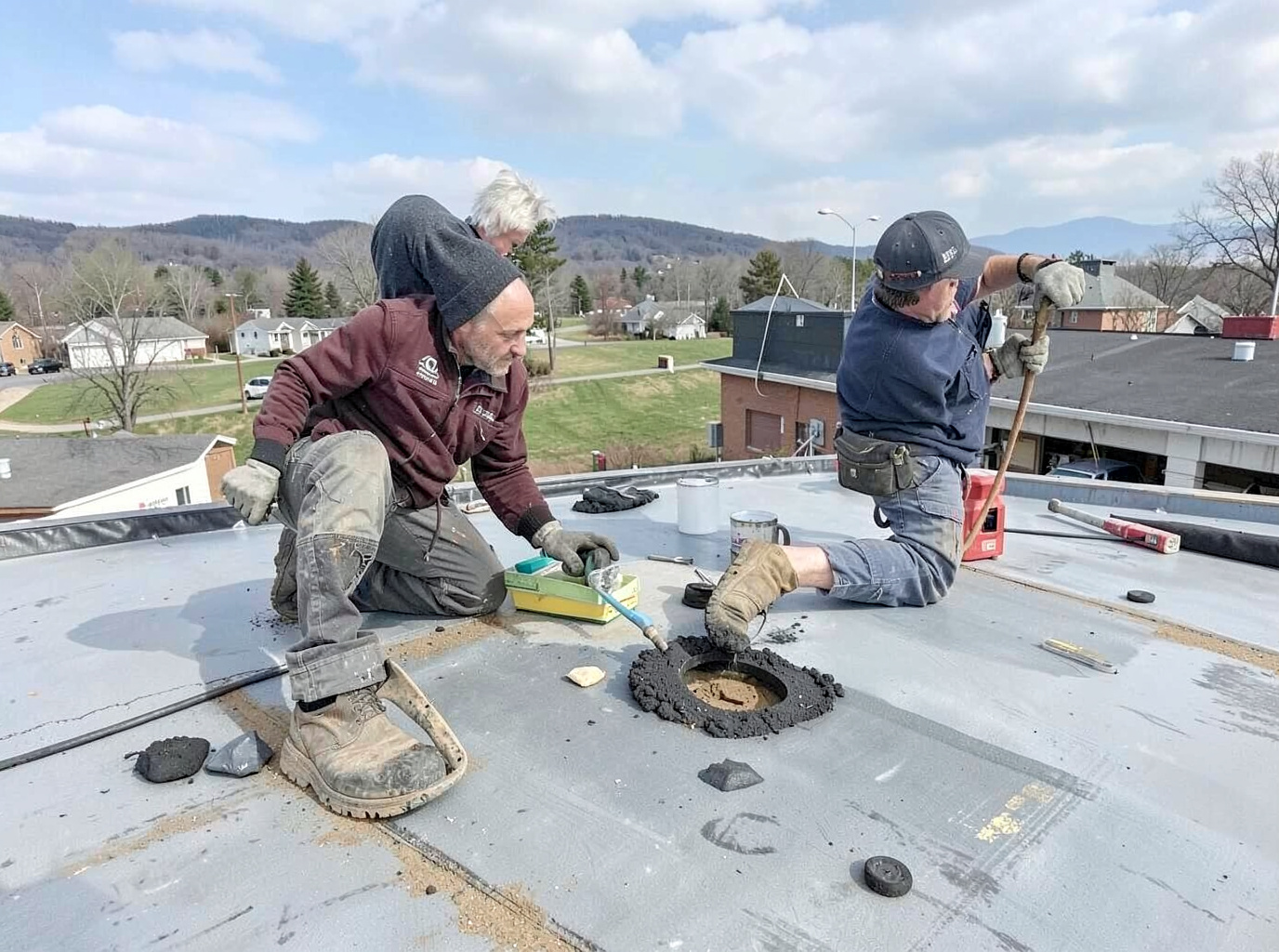
Eau Claire's humid continental climate brings repeated freeze-thaw cycles that stress commercial flat roofs more than sloped ones. Water enters small breaches around HVAC curbs or drains, then expands when temperatures drop below freezing, widening splits in modified bitumen or EPDM membranes. Buildings near the Chippewa River or on the West Side often sit on slightly lower ground where spring runoff pools against parapets, accelerating edge deterioration. Crews here routinely check for trapped moisture under insulation because older downtown stock from the mid-1900s frequently lacks modern vapor barriers.
Repair work on flat roofs in Eau Claire County differs from residential pitched roofs because access requires ladders or lifts rather than simple scaffolding, and traffic from delivery trucks on East Side commercial lots adds vibration stress. Technicians look for ponding near scuppers that freeze solid in January, then thaw and refreeze, cracking flashings at the University of Wisconsin-Eau Claire campus buildings. Proper adhesion of new patches demands temperatures above 40 degrees, so most major work occurs between April and October. Ignoring these seasonal windows leads to repeated callbacks when winter wind drives snow under lifted seams.
Local code requires positive drainage on commercial roofs, yet many properties near Chippewa Falls or La Crosse routes still rely on original internal drains that clog with leaves and debris. When repairing, crews verify slope with a laser level and add tapered insulation where needed rather than simply overlaying new membrane. This prevents ice dams that form along the Chippewa River corridor when warm days melt snow and cold nights refreeze the water at roof edges.
Technician insight
In Eau Claire, the thing that catches most people out with Commercial Flat Roof Repair is how quickly freeze-thaw cycles along the Chippewa River turn a small seam split into widespread wet insulation inside older downtown buildings. Homeowners and property managers often wait until spring leaks appear, but by then the insulation is already saturated and the repair window has narrowed.
West Side Warehouse Ponding Issue
Standing water collected near two scuppers on a 1980s warehouse after heavy spring rain. Core samples showed saturated insulation extending eight feet inward. Crews replaced the wet section, added tapered insulation to restore slope, and installed new welded membrane patches. The roof now drains fully and has remained dry through the following winter.
Commercial Flat Roof Repair Services We Offer
✓Membrane Patching and Sealing
Targeted cuts and heat-welded patches restore watertight integrity on EPDM or TPO surfaces without full replacement.
✓Drainage System Repairs
Clearing and re-sloping scuppers and internal drains stops ponding that freezes and cracks seams each winter.
✓Flashing and Edge Detail Work
Replacement of deteriorated metal counterflashing and termination bars prevents wind-driven water entry along parapets.
✓Insulation and Moisture Assessment
Core sampling and infrared scans locate wet insulation so only damaged sections are removed and replaced.
✓Coating Application Over Existing Membrane
Elastomeric coatings restore UV protection and seal minor cracks on aging built-up roofs common in older Eau Claire commercial stock.
Commercial Flat Roof Repair Cost in Eau Claire, WI
| Service | Typical Range | What Affects It |
|---|---|---|
| Small Leak Repair | $800–$1,800 | Single patch under 100 sq ft; price rises with height or difficult access |
| Drainage Correction | $1,500–$3,500 | Includes tapered insulation and new scupper work |
| Sectional Membrane Replacement | $2,200–$5,000 | Per 500 sq ft zone; varies with existing insulation condition |
| Full Roof Coating | $3,000–$7,000 | For 5,000 sq ft roof; depends on surface prep required |
Ranges are typical for Eau Claire, WI and confirmed with an exact written quote before any work starts.
How it works
- 1
Site Assessment
Walk the roof with the building manager to map leaks, check drainage, and note HVAC penetrations while documenting existing membrane type.
- 2
Moisture Mapping
Use infrared imaging and core cuts to identify wet insulation zones before any repair begins.
- 3
Targeted Repair Execution
Remove damaged sections, install new tapered insulation where needed, weld or adhere replacement membrane, and reseal all flashings.
- 4
Final Drainage Test
Flood test repaired areas and confirm water flows to drains without ponding before leaving the site.
Pricing
Costs depend on roof size, membrane type, and extent of wet insulation; upfront quotes provided after inspection.